
What Is the Best CRM for Travel Agents?
For travel advisors, great service starts with strong relationships. Yet keeping those relationships personal becomes harder when client information is scattered across spreadsheets, emails, booking platforms, notes, and itinerary tools.
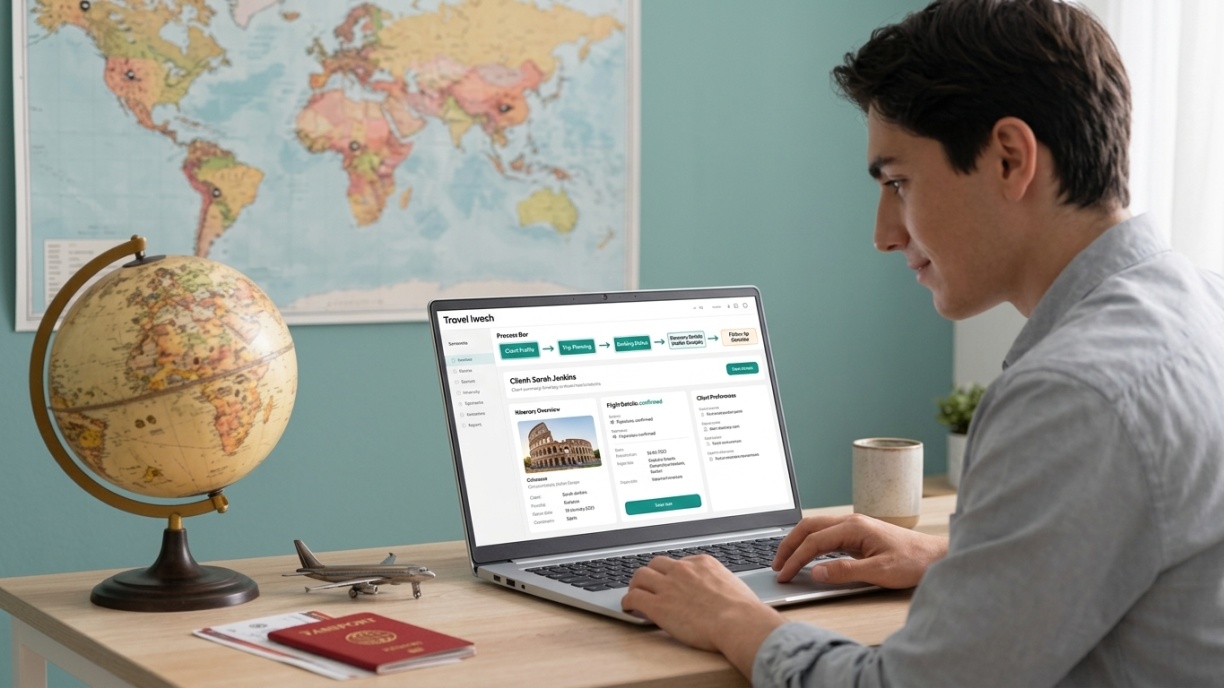
So, what is the best CRM for travel agents?
The answer is not necessarily the platform with the longest feature list. The right travel agent CRM should help you understand your clients, manage leads, organize trips, and deliver excellent service without forcing you to jump between multiple systems.
That matters more than ever. Travel Weekly and Phocuswright’s 2025 Travel Industry Survey gathered responses from 1,562 travel advisors, with 67% identifying as home-based independent contractors or agencies. As more advisors work independently, connected technology can make a significant difference.
Travel Ibex brings CRM, quotations, bookings, financials, itinerary creation, and other agency workflows together in one platform. Get a free Travel Ibex demo and see how an integrated workflow can work for your agency.

What Is a CRM for Travel Agents?
CRM stands for Customer Relationship Management. At its core, CRM software helps businesses organize information about prospects and customers so they can manage relationships more effectively.
For a travel advisor, however, a useful CRM needs to do more than store names and contact details.
Consider everything you learn about a traveler over time: favorite destinations, preferred hotel styles, previous trips, special requests, family members, supplier preferences, budgets, and past conversations. All of that information can help you deliver a more personalized experience.
A good CRM for travel agents keeps that context accessible.
Instead of searching through old emails to remember what a client liked about a previous trip, you can find the information when you need it. That does not make your service less personal. It gives you a smarter way to scale it.
Why Do Travel Agents Need a CRM?
Travel advising remains a relationship-driven business. Industry research continues to highlight the importance of expertise and personal connections in the decision to work with a travel advisor.
A CRM helps turn those relationships into an organized, repeatable process.
Keep client information organized
When client details live in different systems, important information can easily be overlooked. A centralized CRM gives advisors one place to manage profiles, notes, communications, preferences, and trip history.
Prevent leads from slipping through the cracks
Not every inquiry is ready to book immediately. A CRM can track where each prospect stands and remind you when it is time to follow up.
Personalize the client experience
Remembering a client’s preferences can make a recommendation feel genuinely thoughtful. A CRM gives you the information needed to personalize service, even as your client list grows.
Reduce administrative work

CRM software can automate repetitive tasks, organize workflows, and reduce manual data entry. In an analysis of 11 CRM case studies, Nucleus Research found that productivity and process-efficiency improvements accounted for 51% of total CRM ROI.
That means the value of CRM is not limited to generating more sales. It can also give advisors more time to focus on what they do best: advising clients.
What Features Should the Best CRM for Travel Agents Have?
The best travel agency CRM should combine essential relationship-management tools with features designed around the travel sales cycle.
Contact and client management
Look for detailed client profiles, notes, preferences, communication history, and previous trip information. The more complete the profile, the easier it is to provide personalized service.
Lead management
Your CRM should help move prospects from initial inquiry to consultation, quote, booking, and follow-up. Every stage should be easy to track.
Tasks and reminders
Follow-ups, payment deadlines, document requirements, and pre-trip communications are easier to manage when they are tied directly to the client record.
Itinerary and proposal creation
This is where a travel-specific CRM can offer a major advantage. Once you understand what a client wants, you should be able to turn that information into a professional proposal or itinerary without rebuilding the trip in another application.
Booking and financial management
For many agencies, the ideal system connects client records with reservations, transactions, balances, and commissions. This reduces duplicate entry and gives advisors a clearer view of each trip.
Integrations and automation
As your agency grows, integration becomes increasingly important. Your CRM should work with the tools you already rely on instead of creating another isolated data silo.
Client-facing tools
The relationship does not end when the itinerary is sent. Client-facing tools can make it easier for travelers to access their trip information, documents, and itineraries before and during their journey.
Travel Ibex, for example, connects its CRM with quotations, bookings, financial transactions, itinerary creation, supplier information, and its client-facing My Trip Itinerary experience.
Travel-Specific CRM vs. Generic CRM: Which Is Better?

This is one of the most important questions to consider when comparing CRM software for travel agencies.
Generic CRM platforms such as HubSpot, Zoho CRM, and Salesforce can be extremely powerful. They offer advanced sales pipelines, marketing automation, reporting, customization, and broad integration ecosystems.
For larger organizations with complex sales and marketing needs, that flexibility can be valuable.
There is, however, a trade-off.
A generic CRM may require additional systems for itinerary building, bookings, payments, travel documents, supplier management, or client-facing trip information.
A travel-specific CRM starts with these workflows in mind.
That does not automatically make one approach better. The right choice depends on your agency.
Ask yourself:
Would you rather customize a general CRM around your travel business, or use a platform already designed around the way travel agencies work?
For independent advisors and small agencies, fewer disconnected systems can mean less administrative work and a simpler learning curve.
The Best CRM for Travel Agents: Top Options Compared
There is no universal winner. Different platforms suit different business needs.

Travel Ibex — Best for an Integrated Travel Agency Workflow
Travel Ibex combines CRM with the operational side of travel, including quotations, bookings, financials, itinerary creation, supplier information, integrations, and client-facing itinerary delivery.
It is particularly suited to agencies that want the client relationship and the actual trip managed through one connected workflow.
Travefy — Best for CRM and Itinerary Workflows
Travefy has expanded from itinerary and proposal software into CRM functionality, adding tools for client management, tasks, automation, invoicing, and commissions.
It can be a strong option for advisors who place a major emphasis on itinerary presentation and client-facing experiences.
TravelJoy — Best for a Simple All-in-One Advisor Workflow
TravelJoy combines CRM capabilities with payments, forms, messaging, itineraries, and automation.
It can appeal to independent advisors who want several everyday workflows managed within one platform.
Tern — Best for AI and Automation
Tern is particularly interesting for advisors looking toward advanced automation and AI. Its emerging capabilities include using AI to work with travel-related emails and search information within CRM records.
HubSpot — Best Generic CRM for Marketing
HubSpot can be attractive for agencies focused heavily on lead generation, marketing, sales pipelines, and broader customer-management workflows.
Zoho CRM — Best for Budget and Customization
Zoho is worth considering for smaller businesses that want a customizable general-purpose CRM without moving immediately into enterprise-level pricing.
Salesforce — Best for Complex Organizations
Salesforce offers extensive customization, integrations, analytics, and scalability. It can be a strong fit for organizations with more complex technical and operational requirements.
The takeaway is simple: “best” depends on the agency. A solo advisor may prioritize simplicity, while a growing agency may need deeper integrations, financial tools, automation, and reporting.
Why AI Is Changing Travel CRM
AI is quickly becoming part of the CRM conversation.
Travel Weekly’s 2025 survey found that 59% of respondents had used AI platforms or tools, up from 41% the previous year. Advisors showed interest in using AI for marketing content and creating itineraries based on client preferences.
At the same time, advisors are not simply handing the client relationship over to machines. The same research found that 63% had reservations about AI’s accuracy and lack of personal touch.

That highlights an important lesson for travel technology.
AI should not replace the advisor’s expertise. It should remove repetitive work so advisors can spend more time on the human side of travel planning.
Imagine AI helping identify a booking confirmation in an email, summarize previous conversations, or remind you that a past client may be ready to plan another trip. The advisor still makes the recommendation, applies professional judgment, and builds the relationship.
That is where AI-enhanced CRM becomes genuinely valuable.
How to Choose the Best CRM for Your Travel Agency
Before choosing a platform, map your current workflow.
Where do leads arrive? Where do you store client details? How do you create quotes? Where do bookings live? How do you track payments? How do you deliver itineraries? How do you remember to follow up after a trip?
Then identify your biggest bottleneck.
If you are constantly switching between applications, integration may be your priority. If leads are being forgotten, focus on CRM and automation. If creating proposals takes too long, look for integrated itinerary tools. If your agency is growing, pay close attention to scalability and reporting.
Most importantly, do not judge software by features alone. The best CRM is the one your team will actually use.
If you are considering how to bring your CRM, itinerary, booking, and financial workflows together, contact Travel Ibex to discuss what your agency needs.
So, What Is the Best CRM for Travel Agents?
The best CRM for travel agents is the one that makes your entire workflow easier—not just the part where you store contact information.
Generic CRMs can be excellent for marketing, sales, customization, and enterprise requirements. Travel-specific systems can be a more natural fit for advisors who need CRM, itineraries, bookings, financials, and client communication to work together.
As AI becomes more capable, the most useful platforms will be those that automate repetitive work while preserving the expertise and personal attention that make travel advisors valuable.
Ultimately, the question is not simply “Which CRM has the most features?”
It is:
“Which CRM helps me spend more time advising clients and less time managing disconnected systems?”
Ready to see what an integrated travel agency CRM can look like? Request your free Travel Ibex demo and explore how one platform can connect your client relationships with the trips you create, sell, and manage. Share this guide with another travel advisor comparing CRM options, and keep exploring the Travel Ibex blog for more practical advice on building a more efficient travel business.