
Best Travel Agency Software for Small Agencies in 2026: Features, Comparisons, and What to Look For
Running a small travel agency is exciting. Every booking represents a new adventure, a dream fulfilled, and another opportunity to create unforgettable experiences for your clients. Yet behind every successful trip lies a long list of responsibilities. Travel advisors must manage inquiries, build itineraries, coordinate suppliers, track payments, and maintain strong client relationships—all while continuing to grow their business.
In the early stages, spreadsheets, email folders, and standalone tools may seem sufficient. Over time, however, those systems can become obstacles rather than assets. Information gets scattered. Processes take longer than they should. Important details become harder to track. As a result, advisors often spend more time managing operations than serving travelers.
That’s where the right travel agency software can make a significant difference.

A well-designed platform does far more than organize information. It helps agencies streamline workflows, improve communication, increase efficiency, and deliver a better client experience from start to finish.
In this guide, we’ll explore what small agencies should look for in travel agency software, review some of the leading solutions available today, and explain why many agencies are moving toward all-in-one platforms to support sustainable growth.
Ready to see how a complete travel agency management platform would help your business operate more efficiently? Schedule your free personalized demo today!
Why Small Travel Agencies Need Specialized Software

Travel agencies have unique operational needs. Unlike many businesses, they must manage detailed itineraries, supplier relationships, client preferences, booking information, payments, commissions, and ongoing communications throughout the customer journey.
Because of this complexity, generic business software often falls short.
Many agencies attempt to fill the gaps by combining several different systems. One platform manages customer information. Another handles itineraries. A third tracks finances. While each tool may perform its individual task well, the overall process often becomes fragmented and inefficient.
The more systems you use, the more difficult it becomes to maintain consistency and visibility across your business.
Specialized travel agency software solves this challenge by bringing critical functions together in one place. Advisors can manage leads, create proposals, monitor finances, communicate with clients, and analyze performance without constantly switching between applications.
For small agencies with limited time and resources, that level of efficiency can be transformative.
Common Challenges That Hold Small Agencies Back
Growth is exciting, but it often exposes weaknesses in existing processes. As booking volume increases, manual workflows become harder to manage and more costly to maintain.
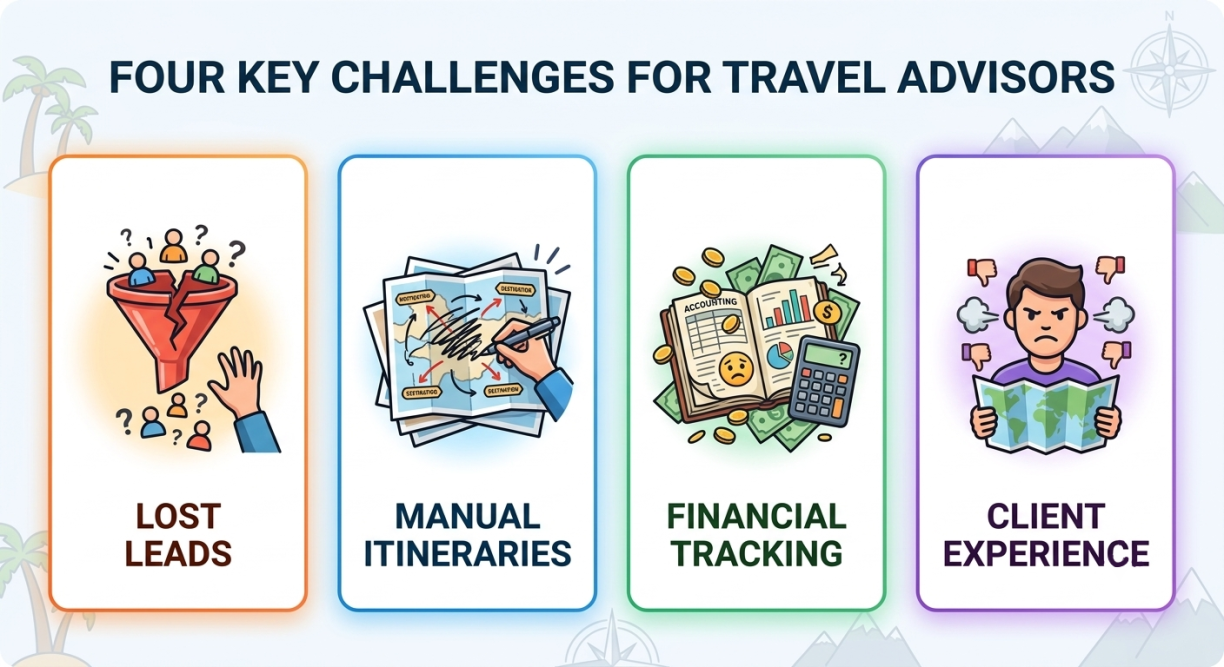
Let’s look at some of the most common challenges travel agencies face.
Managing Leads Across Multiple Channels
Travelers discover agencies in many different ways. They may submit a website inquiry, respond to an email campaign, connect through social media, or arrive via a referral.
Without a centralized system, keeping track of every opportunity becomes increasingly difficult.
A missed follow-up doesn’t just mean a missed email—it can mean a lost booking.
That’s why a travel CRM is so important. It allows advisors to organize inquiries, track conversations, manage opportunities, and maintain visibility throughout the sales process.
Spending Too Much Time Creating Itineraries
Custom trip planning is one of the most valuable services travel advisors provide. Unfortunately, it can also be one of the most time-consuming.
Many agencies still build proposals manually, copying content between documents and reformatting information for every new client. Not only is this inefficient, but it also increases the risk of mistakes.
Modern itinerary builder software simplifies the process. Advisors can create professional, branded proposals quickly while spending more time on personalization and less time on formatting.
Struggling to Track Financial Performance
Financial management is essential to agency growth, yet many advisors still rely heavily on spreadsheets.
Tracking supplier payments, client invoices, commissions, deposits, and profitability across multiple tools can quickly become overwhelming.
The right software provides a clearer financial picture. Instead of hunting for information, agency owners can access the data they need to make informed business decisions.
Meeting Rising Traveler Expectations
Today’s travelers expect convenience. They want immediate access to trip information, documents, confirmations, and updates from any device.
If clients need to search through dozens of emails to find important details, frustration can build quickly.
Providing a centralized traveler experience helps agencies deliver better service while reducing the number of routine support requests.
The Most Important Features to Look For
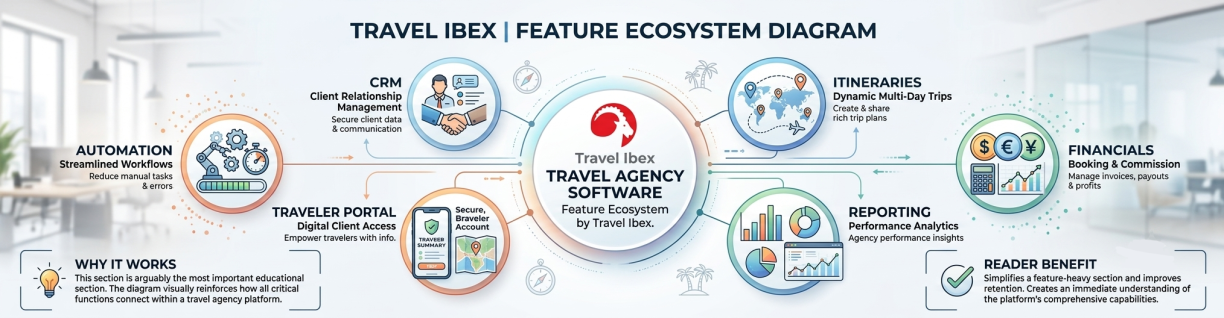
Not all travel agency software offers the same capabilities. While every agency has different priorities, several core features consistently provide the greatest value.
Customer Relationship Management (CRM)
Every successful agency depends on strong client relationships.
A travel CRM helps advisors stay organized while delivering more personalized service. The best solutions allow you to:
- Track leads and inquiries
- Store traveler preferences
- Monitor communications
- Automate follow-ups
- Manage sales pipelines
When all client information is easily accessible, advisors can respond faster, provide better service, and build stronger long-term relationships.
Professional Itinerary and Proposal Builder
Your proposal often serves as your first opportunity to impress a prospective client.
An effective itinerary builder should help you create polished, professional documents without requiring hours of manual work.
Look for features such as:
- Drag-and-drop editing
- Reusable templates
- Custom branding
- Easy updates
- Digital sharing capabilities
Travel Ibex’s drag-and-drop Builder helps advisors create beautiful quotes, itineraries, and traveler documents while maintaining a consistent brand experience across every interaction.
Traveler Portal and Mobile Access
Travelers increasingly expect a digital experience that feels simple and intuitive.
Modern travel software should make trip information easy to access before, during, and after travel. Mobile-friendly itineraries, downloadable documents, and centralized trip details can significantly improve the client experience.
Travel Ibex’s My Trip Itinerary feature provides travelers with a personalized URL where they can access itinerary details and download important travel documents whenever needed.
Financial Management Tools
Strong financial visibility supports smarter decision-making.
Look for software that includes:
- Invoicing
- Payment tracking
- Supplier management
- Commission tracking
- Profitability reporting
When financial tools are integrated into your platform, administrative work decreases and reporting becomes more accurate.
Reporting and Business Insights
You can’t improve what you don’t measure.
Reporting tools help agencies understand what’s working, identify opportunities, and make data-driven decisions.
Useful reports often include:
- Revenue trends
- Conversion rates
- Booking performance
- Advisor productivity
- Profitability metrics
The more insight you have into your business, the easier it becomes to plan for future growth.
Why All-in-One Platforms Are Becoming the Preferred Choice
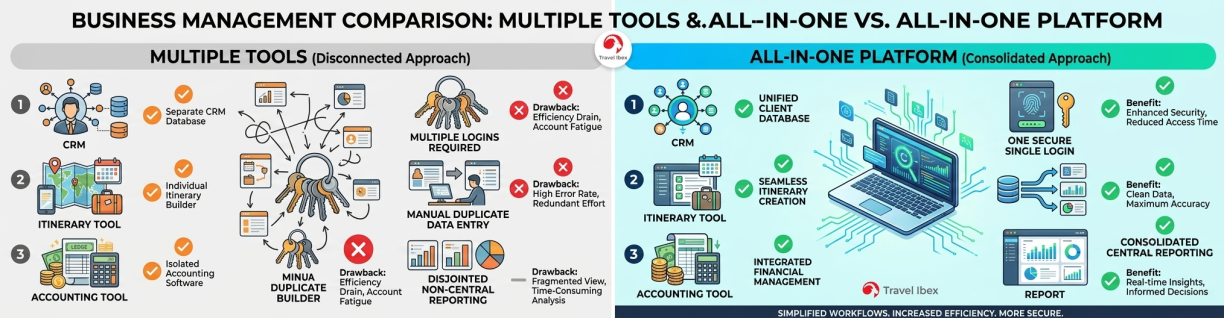
Over the last several years, many agencies have shifted away from disconnected software ecosystems and embraced integrated platforms instead.
The reason is simple: simplicity scales.
Managing five or six separate tools creates friction. Data must be entered multiple times. Reporting becomes fragmented. Team members spend valuable hours moving between systems.
An all-in-one travel agency platform eliminates many of these challenges.
By centralizing operations, agencies can:
- Reduce software costs
- Minimize duplicate work
- Improve collaboration
- Strengthen reporting accuracy
- Simplify onboarding
- Deliver a more consistent client experience
Perhaps most importantly, integrated platforms free advisors to focus on revenue-generating activities rather than administrative tasks.
Best Travel Agency Software for Small Agencies
Choosing the right platform depends on your business goals, workflow requirements, and long-term growth plans. Here are several solutions worth considering.
Travel Ibex
Travel Ibex was built specifically for independent travel advisors and small-to-medium travel agencies seeking an all-in-one solution.
Key features include:
- CRM and lead management
- Drag-and-drop itinerary builder
- Branded proposals and traveler documents
- Financial management tools
- Booking integrations
- Reporting and analytics
- E-commerce capabilities
- My Trip Itinerary traveler portal
Because Travel Ibex supports the entire customer journey—from lead generation through post-trip follow-up—it helps agencies streamline operations while creating a more connected client experience.
Travefy
Travefy is best known for its itinerary-building capabilities and client-facing trip management tools. Advisors who prioritize visual trip presentations often find it appealing.
However, many agencies supplement it with additional systems for CRM and financial management.
TravelJoy
TravelJoy focuses heavily on workflow automation and client management. Independent advisors often appreciate its forms, communication tools, and lead management capabilities.
Depending on operational requirements, agencies may still need additional software for broader business functions.
Axus Travel App
Axus is particularly popular among luxury travel advisors. Its strengths lie in itinerary presentation, mobile experiences, and traveler engagement.
Many agencies pair it with other systems to manage financial and operational processes.
HubSpot
HubSpot offers a powerful CRM and marketing automation platform. While it can be adapted for travel businesses, agencies often need supplemental travel-specific tools for itinerary creation, bookings, and supplier management.
How to Choose the Right Travel Agency Software
Before investing in a new platform, take a step back and evaluate both your current challenges and future goals.
Ask yourself:
- Does the software support my entire workflow?
- Can it scale as my agency grows?
- Is it designed specifically for travel professionals?
- Will it improve the traveler experience?
- Can it reduce administrative workload?
The best software doesn’t simply solve today’s problems. It creates a foundation for tomorrow’s growth.
Final Thoughts
The best travel agency software for small agencies helps advisors do more than stay organized. It enables them to work smarter, serve clients better, and grow with confidence.
By centralizing operations, automating repetitive tasks, improving communication, and providing valuable business insights, the right platform becomes a true growth partner.
As traveler expectations continue to evolve, agencies that invest in modern technology will be better positioned to stand out, scale efficiently, and build lasting client relationships.
Your agency’s next stage of growth may not depend on working harder. It may simply depend on having the right technology behind you.